July 15, 2026
A Look at the Day-to-Day Reality
Many franchise candidates research the business model, review the numbers, and assess the market before asking the question that matters most: what will I actually be doing every day? For a Smash My Trash® franchise owner, the answer is less about operating equipment and more about running a business. Understanding that distinction is essential before moving forward.
The Owner’s Role: Running the Business, Not the Truck
The most important clarification for prospective franchisees is this: the franchise owner is not the driver. Smash My Trash® franchisees are business operators. They build and manage a team, develop and maintain a client base, monitor financial performance, and coordinate daily operations.
The Smash Trucks™ are operated by hired drivers, typically one W-2 employee per truck. That staffing structure keeps the owner focused on business growth. Truck maintenance is generally outsourced to 1099 contractors with hydraulic and diesel expertise. Some owners who know their trucks well will handle common maintenance tasks themselves and are willing to step in and drive when needed.
For candidates who come from a sales, management, or operations background, this structure will feel familiar. The owner’s primary focus is business development, team leadership, and growth.
Sales and Customer Relationship Management
In the early stages of building a territory, the franchise owner is likely to lead business development efforts. That means identifying target accounts, conducting on-site demonstrations, following up with prospects, and closing new clients.
The sales model is straightforward. Smash My Trash® uses a “try it before you buy it” approach, where operators demonstrate the service live at a prospect’s location. The compaction results speak for themselves. Reducing waste volume by up to 70% in a single visit delivers a visible, quantifiable result. For many customers, that translates to an estimated 15-25% reduction in total waste management costs, making the sales conversation concrete rather than abstract.
Once a client is secured, relationship management becomes the priority. Consistent service delivery, responsive communication, and measurable results drive retention. Because the revenue model is contract-based and recurring, client retention directly affects the financial stability of the business.
Scheduling and Operational Coordination
The franchise owner is responsible for coordinating service schedules across the client base. That includes route planning, driver dispatching, and ensuring trucks are maintained and available. As the business grows and additional trucks are deployed, some franchisees hire a General Manager or Operations Manager to handle day-to-day coordination. Ultimately, however, the owner remains responsible for operational performance at the territory level.
Franchisees have access to technology systems that support scheduling and route management. The franchisor also provides ongoing operational guidance through the Operations Manual, written communications, and direct consultation. That infrastructure reduces the learning curve, but the owner remains responsible for execution at the territory level.
Team Oversight and Leadership
Smash My Trash® franchisees typically manage a lean team. A single-truck operation generally involves one driver and a salesperson, with outsourced truck maintenance. As the business scales, additional drivers and sales staff are added.
Hiring, training, and retaining that team is a core owner responsibility. The franchisor provides support resources in hiring and retention, but day-to-day people management falls to the franchisee. Owners who build strong, accountable teams are better positioned to step back from daily execution and focus on growth.
Franchisee testimonials in the Smash My Trash® Franchise Information Guide consistently point to team culture as a differentiator. Multi-unit operators in particular emphasize the importance of investing time in the business during the first year to understand every function before delegating.
Financial and KPI Management
The franchise owner monitors the financial performance of the business on an ongoing basis. That includes tracking gross sales, managing operating costs, reviewing profitability by truck and territory, and planning for growth investments such as additional equipment.
Key performance indicators in this model include client count, service visit frequency, route efficiency, customer retention rate, and revenue per truck. The franchisor provides ongoing support in financial management and profitability, and franchisees have access to performance dashboards that support data-driven decision-making.
According to Item 19 of the 2026 Franchise Disclosure Document (FDD), the 107 covered franchised businesses operating during the full 2025 calendar year averaged approximately 5 territories and 3 trucks. The highest-volume operator ran 28 territories and 14 trucks. That range reflects the financial and operational upside available to owners who execute consistently.
For a closer look at the scalability of this model, including the three paths for growth, see our earlier analysis.
What This Opportunity Requires
Smash My Trash® is built for operators who are hands-on, sales-minded, and comfortable managing people and processes. The service model is straightforward. The equipment is proprietary. The customer value proposition is demonstrable and measurable. What separates high-performing franchisees from the rest is consistent execution in sales, operations, and team leadership.
The franchise provides the system, the technology, the training, and the support infrastructure. The owner provides the drive to build the business within that framework.
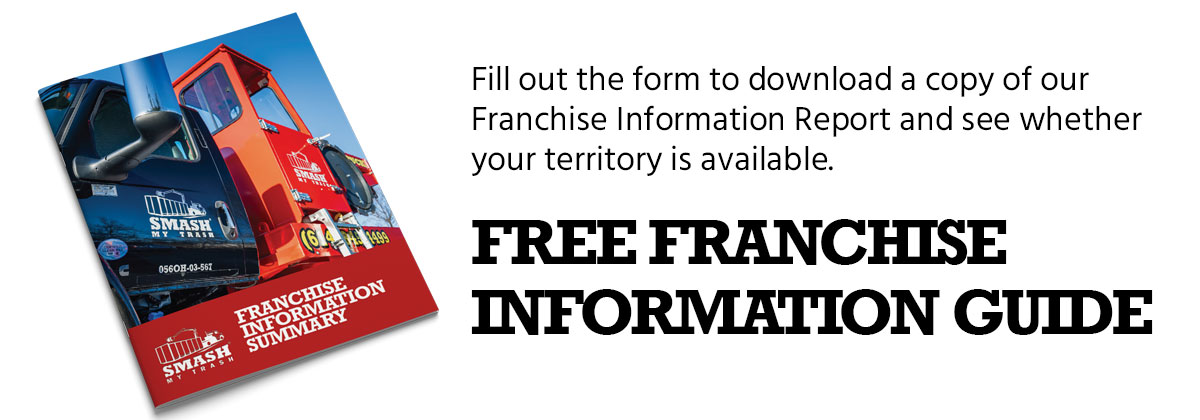
To learn more about Smash My Trash®, visit the franchise website and download the Franchise Information Guide.
Sources:
Smash My Trash®, Franchise Information Guide.
Smash My Trash®, 2026 Franchise Disclosure Document, Item 19.