June 24, 2026
Commercial waste management is a multi-billion-dollar industry, and for the businesses that rely on open-top roll-off dumpsters, the hauling model has not changed much in decades. Containers fill up, a truck is called, and an invoice follows. Smash My Trash identified an inefficiency in that model and built a business around fixing it. That inefficiency is the foundation of the Smash My Trash business model, and it is the first thing a serious investor should understand.
Brand Differentiation: A Proprietary Service with No Direct Equivalent
Smash My Trash® operates proprietary Smash Trucks™ equipped with a specialized hydraulic steel drum that compacts waste inside open-top roll-off dumpsters. The service is mobile, so the compaction happens on-site without removing or replacing the container. Because the service works within a client’s existing waste setup, it requires no changes to infrastructure or workflow, which lowers the barrier to adoption. The technology is proprietary, the equipment is specialized, and the operational model is distinct from traditional waste hauling. That combination creates meaningful competitive insulation.
Industry Positioning: Disrupting a Multi-Billion Dollar Industry
According to Grand View Research, the U.S. waste management market generated $375.4 billion in revenue in 2025 and is expected to reach $569.2 billion by 2033, growing at a compound annual growth rate of 5.4%. Smash My Trash® operates within the commercial and industrial segment of that market, specifically serving businesses that rely on open-top roll-off dumpsters for waste disposal.
Within that segment, mobile on-site waste compaction represents an emerging and differentiated service, one that addresses inefficiencies traditional hauling has never solved. The brand has been recognized on Entrepreneur Magazine’s Franchise 500 and Fastest-Growing Franchise lists and reports a 99% customer approval rating.
Customer Demand: Driven by Operating Necessity, Not Discretionary Spending
Waste is a byproduct of doing business. Smash My Trash serves commercial and industrial clients, including manufacturing facilities, distribution centers, logistics and transportation companies, big-box retailers, commercial construction firms, automotive facilities, and oil and gas operations. Any business that consistently generates a significant volume of waste is a potential client.
Demand is not tied to consumer foot traffic or economic sentiment. The service addresses a real, recurring operational cost, and customers notice the impact. Compacting waste volume by up to 70%, the service reduces haul frequency and delivers an estimated 15 to 25% reduction in total waste management costs.
Scalability: Growth Follows Demand, Not Real Estate
Smash My Trash® does not require a storefront, retail buildout, or long-term commercial lease. The model offers three defined paths for growth. The first is a single-territory owner-operator model, starting with one truck and one driver. The second involves adding customers, increasing route density, and deploying additional trucks within an existing territory. The third involves acquiring multiple territories from the outset or expanding into adjacent territories over time, building a fleet, and scaling toward a managed, multi-territory operation.
According to the 2026 Franchise Disclosure Document (FDD), the 107 covered franchised businesses operating during the full 2025 calendar year averaged approximately 5 territories and 3 trucks. The highest-volume operator in the system ran 28 territories and 14 trucks.
Recurring Revenue: Contract-Based, Predictable, and B2B
Smash My Trash franchisees build service relationships with commercial accounts that need regular compaction. Since waste generation is continuous, service schedules tend to repeat week after week. Revenue is not transaction-dependent or tied to one-time sales, which supports a more predictable cash flow than many franchise models.
Because the business generates revenue from completed service visits rather than product sales, there is no inventory to purchase, carry, or write off. More of the revenue coming into the business stays available to the owner. That distinction matters when evaluating cash flow and sets this model apart from franchise concepts that depend on product margins to drive profitability.
The business also benefits from two distinct account types: local commercial clients secured through territory-level sales, and national accounts managed at the corporate level and passed to franchisees operating in the relevant markets. National accounts can provide a meaningful revenue layer on top of an owner-built client base, without requiring the franchisee to source or close those relationships independently.
Operational Advantages: Low Overhead, Mobile, and Asset-Efficient
The model operates without the fixed-cost structure common to brick-and-mortar franchises. There is no customer-facing location to staff or maintain. Capital goes toward revenue-generating equipment rather than leasehold improvements. Each truck operates as a mobile profit center. The staffing model is lean: typically one driver per truck, a salesperson, and outsourced truck maintenance handled by 1099 contractors. The total estimated initial investment for a single territory ranges from $372,050 to $492,200, with the Smash Trucks representing the primary capital outlay.
The result is a business where the primary asset is also the primary revenue driver, with limited fixed costs standing between the operator and profitability.
Support Systems: Structured from Day One
Franchisees enter a system with training, marketing, technology, and operational infrastructure already in place. Initial training totals 39 hours, 7 in the classroom and 32 in the field, covering territory planning, equipment operation, sales, customer service, financial management, and go-to-market execution.
Ongoing support covers all functional areas of the business and is delivered through the Operations Manual, written communications, electronic media, telephone consultation, and on-site visits.
In Summary
Smash My Trash offers franchise candidates a business model built on proprietary technology, consistent commercial demand, low overhead, and a clear path to scale. The service addresses a real and growing cost problem for businesses across multiple industries. For candidates seeking a B2B franchise with recurring revenue and a defensible market position, Smash My Trash is worth serious consideration.
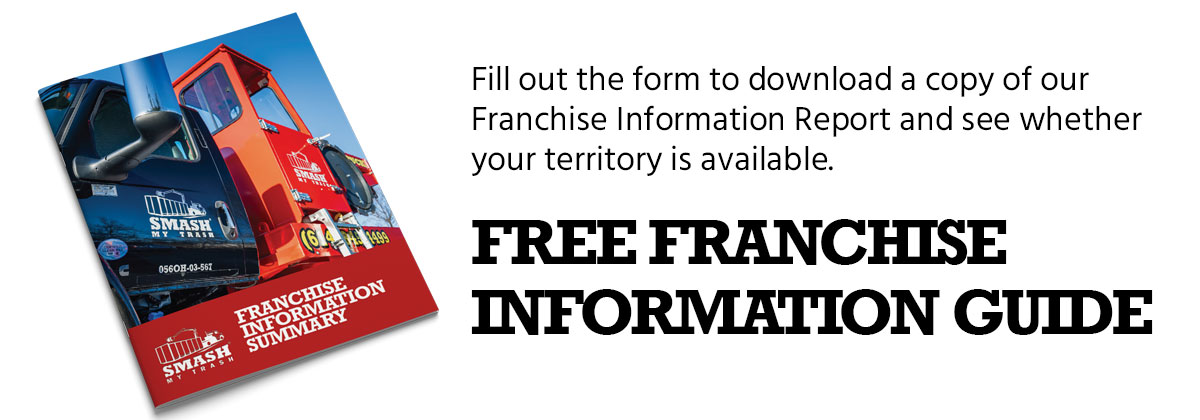
To learn more about Smash My Trash, visit the franchise website and download the Franchise Information Guide.
Sources:
Grand View Research, Waste Management Market Size & Share Report, 2026-2033
Smash My Trash, Franchise Information Guide.
Smash My Trash, 2026 Franchise Disclosure Document, Item 7
Smash My Trash, 2026 Franchise Disclosure Document, Item 11
Smash My Trash, 2026 Franchise Disclosure Document, Item 19